Tuesday, February 28, 2023

FTPL Videos

 Two great videos just dropped related to fiscal theory. 


The first is an "Uncommon Knowledge" interview with Peter Robinson. We start with fiscal theory and move on far and wide. Peter is a great interviewer, and the Uncommon Knowledge production team put together a great video of it. Pick your link: Video at Hoover (best, in my view); Hoover event page with podcast, links and more info, Youtube, Twitter, Facebook


Second, Michael Strain at AEI moderated a great panel discussion on fiscal theory with me, Robert Barro, Tom Sargent and Eric Leeper. Three of the founding fathers of fiscal theory offer thoughtful comments, and Michael had provocative questions. I start with a 20 minute presentation, with slides, so this is the most compact "what is the fiscal theory" video to date. It's at the AEI event page or Youtube 

Friday, February 24, 2023

Mulligan and the demand for opioids

This is another post from an Economic Policy Working Group meeting at Hoover, in which simple undergraduate supply and demand analysis, creatively applied, leads to a surprising result.  

Casey Mulligan presented "Prices and Policies in Opioid Markets." Paper, slides and video of the presentation.  (Updated link now works) 

Once prescription opioids became an evident crisis, the government took steps to restrict the supply, raising the price. Yet opioid consumption and overdoses went up. Explain that Mr. Chicago economist! 

Here's the clever answer: 

There are two ways to buy opioids, 1) legally or semi-legally; i.e. get opioids that come from pharmaceutical companies and are prescribed to someone by a doctor or 2) illegally. 

There is a fixed cost of entering the illegal market. .".Avoiding theft, acquiring self-dosing skills, or overcoming fear of needles. ...establishing a trusting relationship with a drug dealer...." But the cost per dose of illegal drugs is typically less than for legal drugs. 

So, imagine a drug user starting at B. At that price for legal (red) and illegal (black) drugs, the user chooses legal drugs at point B. Now raise the price of legal drugs, as shown by the arrow. If the user stayed with legal drugs, he or she would use less. But now there is an option, incur the fixed cost and buy illegal drugs on the black line. At the higher price for legal drugs that makes sense. But since the marginal cost of illegal drugs is lower, once the user has overcome the fixed cost, he or she uses more. 

Raise the price, and they consume more (of a substitute). 

The paper checks several predictions of the model, including timing that the surge in illegal use coincided with greater regulation of legal drugs. Another test (sad):  

Here's what happened to prices


"In the earlier years, opioid subsidies are created and expanded for patients and prescribers while regulations are relaxed. In about 2010 policies begin to swing in the other direction as the with reformulation (see below) and programs discouraging prescription supply to secondary markets. ... enforcement of illicit-drug prohibitions was less of a priority between 2013 and 2016.
 (i) heroin was significantly more expensive per MGE than Rx opioids in the 1990s, (ii) illicit opioids became cheaper over time, especially since 2013, and ultimately cheaper than Rx opioids, and (iii) beginning in about 2011, Rx opioids became more expensive or difficult to access for nonmedical use due to regulatory and fiscal changes. 
Second fact, 


The model makes sense of this pattern. Under the reasonable assumption that Blacks have a harder time getting prescription opioids, they would naturally be less open to the prescription opioid boom. But once illegal opioids become a lot cheaper, Black users who are largely confined to the illegal market anyway, expand greatly. 

The discussion was interesting. Most of the commenters wanted to add sensible complications to the model. The fact that opioids are addictive seems like an obvious one. But admire the art in what Casey has done: stripped the model down to the absolute minimum that explains the phenomenon. Stripping models down is hard. 

Update:

The weekend New York Times has a long opinion piece on opioids, with a very humane emphasis on the people and their struggles. Like so many, however, they fail to ask the economists' obvious question: Where do addicts, especially homeless, get the money to buy drugs? (One might object to Casey's economic analysis, and claim drugs are unlike other goods. They're not. Higher prices do lead to less consumption.) One little quote stuck out
The tide of needle litter came in heavy at the start of every month, when benefit checks arrived and people were briefly flush. .... There were far fewer by month’s end, but when the first of the month came again, a fresh swell always followed. 

Michael Shellenberger thought to ask the question, receiving a different and even more uncomfortable answer, theft, though also benefits here

Don't jump from these observations to a policy conclusion, which is not my point. I don't have an easy solution to the combination of drugs and homelessness. But following the money is surely a question that needs to be asked if we wish to understand the forces behind widespread addiction, and the externalities that drug users create. This might be a case in which paternalism is justified, and cash benefits not such a good idea. 

Meanwhile, drug use is apparently way down in Afghanistan,  by methods that we would not want to use, but an interesting fact (and an absorbing report) as well. 

Short and long run minimum wage


On Wednesday, Erik Hurst presented a lovely paper, "The Distributional Impact of the Minimum Wage in the Short and Long Run," written with Elena Pastorino, Patrick Kehoe, and Thomas Winberry, at the Hoover Economic Policy Working Group seminar. Video (a great presentation) and slides here

This is a beautiful and detailed model, which won't try to summarize here. I write to pass on one central graph and insight. 

Suppose there is some "monopsony power," at the individual firm level. Don't argue about that yet. Erik and coauthors  put it in, so that there is a hope that minimum wages can do some good, and it is the central argument made by minimum wage proponents. In the paper it comes because people are uniquely suited to a particular job for personal reasons. Professors don't like to move, they've figured out the ropes at their current university, so the dean can get away with paying less than they could get elsewhere. Why this applies to MacDonalds relative to the Taco Bell next door is a good question, but again, the point is to analyze it not to argue about it. 


"Labor demand" here is the marginal product of labor. (\(f'(N)\) It's what labor demand would be in a competitive market. The monopsnists' demand is lower). Monopsony means that the "marginal cost of labor" rises with the number of employees. There is a core of people that really love the job that you can hire at low cost. As you expand, though, you have to hire people who aren't that attached to this particular job, so you have to pay more. And you have to pay everyone else more too, (by reasonable assumption -- no individually negotiated wages), so the average cost of labor rises. 

Thus, the monopsonies firm chooses to hire fewer people \(N_m\),  produce less, and pay them a wage \(W_n\) below their marginal product.  ("Average cost of labor" is really the labor supply curve, call it \(w=L(N)\). Then \(\max (f(N)-wN\) s.t. \(w=L(N)\) yields \(f'(N)=w+NL'(N)\). The "marginal cost of labor" in the graph is this latter quantity: the wage you pay the last worker, plus all workers times the extra wage you must pay them all. Disclaimer: the equations are me reverse-engineering the graph.) 

Now, add a minimum wage. As the minimum wage rises above \(W_m\), we initially see a rise in the number of workers, and their incomes. The firm moves along the arrow as shown. (\(\max f(N)-wN\) s.t. \( w \ge L(N)\), \( w \ge w^\ast\) gives \(w^\ast = L(N)\) .) 

Keep raising the minimum wage, though. Once we get past the point that labor supply ("average cost of labor") requires a wage greater than the marginal product of labor, the firm turns around and hires fewer people: 


(Really, the problem all along was \(\max_{w,N} f(N)-wN\) s.t. \( w \ge L(N)\), \( w \ge w^\ast\). Once the minimum wage rises enough, the solution \(w^\ast=L(N) \) has \(f'(N)<w^\ast\). The firm does better by hiring fewer people than are willing to work at that wage. With the second constraint slack, \(f'(N)=w^\ast\) is the optimum.) 

So, in this best case, minimum wages do first raise employment, and income. But if you keep going, they eventually turn around and lower employment and raise unemployment (people between the equilibrium and the "average cost of labor" curve want jobs but can't get them.)  We join the local "monopsony" view with the latter "neoclassical" view. 

The actual model is way more realistic, with multiple kinds of workers, firms that can substitute between workers, dynamics that include capital investment in worker-specific technologies, a search model for unemployment and more. Each seems to me just complicated enough to capture an important effect. Multiple kinds of workers is really important: a big part of the "labor demand" is not just a fixed marginal product of a given kind of worker, but the firm's ability to substitute other kinds of workers and machines for a given task. It's nicely calibrated to match the US economy. 

A bottom line: 


Start raising the minimum wage from $7.50.  At first, this raises employment of low-skilled workers, but the above mechanism. It does nothing to medium and high skill workers, since they are already being paid more than the minimum wage. (I'm not sure why we don't see substitution toward higher skills here.) As the minimum wage rises toward $10, however, we hit the neoclassical part of the low-skill curve, and it starts hurting low-skill employment. In their calibration, "monopsony" lowers wages by about 25%, so once the minimum wage has cured that, i.e. about $10 an hour, workers are being paid their marginal products, so requiring even more just quickly lowers their employment. 

Bit by bit the minimum wage starts to help each group as it hits the point between what they are actually paid and their marginal product. 

People whose marginal products are less than $7.50 an hour are missing from the picture. They were already driven out of the market by the current minimum wage.  (The conclusions about the optimum minimum wage are potentially flawed by this omission. It could be even less!) 

This is a lovely story. An obvious implication: Don't quickly generalize too far from local estimates or small interventions.  Big minimum wage changes can have the opposite effects as small ones! 

The big question of minimum wages is always which workers are helped vs hurt, not overall labor. Much of the other work on minimum wages (Jeff Clemens, for example) emphasizes that it helps a few, who can work the hours employers want, are already skilled, speak English, etc., at the cost of many others, who tend to be less well off to start. 


The dynamic part of the paper is great too. Minimum wages are like rent controls: the damage takes time to show up. In the model, dynamics show up as firms have structured their capital to the current employment mix. It takes time to put in, say, video screens to substitute away from order-takers. 

The shaded part is the duration of typical studies. Studies that examine the short run reactions to small minimum wage changes completely miss the long-run effect of large changes. 

Finally, once again, the minimum wage like so many other policies, is an answer in search of a question. If the issue is "how does policy address labor market monopsony," the minimum wage is a very ineffective answer to that question.  Once you spell out the nature of the actual problem, all sorts of other policies are more effective. If you fix the monopsony, wage subsidies are better. But starting with figuring out why there is monopsony in the first place and what policies are inadvertently supporting it is better still.  

****

Update: "Minimum Wages, Efficiency and Welfare" by David Berger, Kyle Herkenhoff and Simon Mongey is a similar paper along these lines -- careful modeling of minimum wages with heterogeneity of workers and firms.  

This paper adds different kinds of firms: From Simon:

"when you start accounting for firms also being heterogeneous... a similar logic carries over. A small minimum wage lifts employment at the small firm with a slither of monopsony power before tanking them, while it's tanking them it starts raising employment at the slightly bigger firm, then tanks that. By the time you get up to the wages paid by any firm that might have considerable market power you've blown up employment at a whole load of firms. A perturbation argument essentially leads you to never increase the minimum wage."

Put another way, a minimum wage increase from $7.50 to $9.00 might actually increase employment at McDonalds... because it puts all the taco stands out of business. Then at $12.00, McDonalds goes out of business but Applebees expands, and so forth. (Or, "corner store" and "supermarket" in Simon's beautiful slides with lots of great supply and demand graphs.) 

They find that the efficiency maximizing minimum wage is close to where we are now. "Efficiency" means "offsetting monopsony." As in Hurst et al, only a small sliver of people are actually hurt by monopsony and helped by the minimum wage. Everyone whose productivity is below $7.50 an hour is already out of the labor force, and everyone whose productivity is higher than the proposed minimum wage is largely unaffected: 


 Again, "raise the minimum wage to offset labor monopsony" is an answer in search of a question. (They go on to evaluate redistribution, which I didn't look at. But I will ask the same question. "raise the minimum wage to redistribute income" sounds to me like an answer in search of a question; if the question is "redistribute income with minimum economic disincentive" I bet there are better answers.) 


****

Update 2. Now, let's think a bit about this "monopsony" business. Both papers include monopsony really for good rhetorical reasons: Let's give the model some reason for minimum wages. Both cite long literatures. Hurst et al summarize that wages are about 25% less than marginal products. Really? At McDonalds? 

Without getting in to the weeds, think for a minute just how hard this is. What is the marginal product of workers at your job? The marginal product of an extra professor in your department? That's awfully hard to measure! Kudos to those who try. It's easier to measure average products: how much the company makes, divided by number of employees. But wages should be below average products. Someone has to pay for the other inputs and a competitive return to capital. Did we really tease out average vs. marginal products? Well, build a model, add lots of assumptions, and here we go. That's the best we can do, but recognize how hard it is. 

Pervasive monopsony means two things, both suspicious. First, it means that each company would have to pay more to hire more people, to do the exact same job as current people, and then it has to pay everyone more. The labor supply curve to the company is upward sloping. That's key in the graph above. Really? Do a restaurant really have to pay everyone more in order to get one more employee? Second, it means there are substantial "rents." Where does the extra 25% go? Not just to an ordinary return to capital, but to extraordinary profits. Together with the view that price markups over marginal costs are large, it's just hard to see large monopoly and oligopoly rents spewing out of businesses. 

I think this illustrates two problems in our general economic discourse. First, econ 101 tends to be a week of how a hypothetical free market works, and then a 9 week litany of market failures, each remediable by an omniscient "planner" -- monopoly, monopsony, externality, asymmetric information, and so on. Our students, like two year olds with hammers, go out and see those nails. But are they really there, and are the available instruments actually able to fix them? 

Second, there is a pervasive tendency for answers to search for questions. Clearly the minimum wage came first, a centuries old idea, long before monopsony. Monopsony is only the latest item in the shopping cart of reasons for a pre-exiting policy idea. As above, if the question is monopsony, however, the answer is not a minimum wage. This problem abounds. (If the question is how to raise GDP 5% in 100 years, there are 99 answers better than force everyone to buy electric cars today, for example.) 

Let's be honest. The idea behind minimum wages is to try to transfer income from businesses -- and thus from their customers, investors, and high-wage workers -- to low-wage employees. Mongey et al. explicitly consider "redistribution" as an objective, and this is the objective. The many unintended consequences -- more unemployment, lower employment, favoring the better off at the expense  of the most precarious of low-wage employees, etc. -- bear on that issue. Here to, though,  if the question is "how should we redistribute income to low-wage workers" or even "how should we improve the lot of low-skill workers," there are 100 better answers. The EITC looks better in Hurst et al, though it too has many problems including a very high marginal tax rate as it phases out. 

Economic discourse would be a lot more productive if instead of focusing on answers that have been around a long time -- let's find a new reason for minimum wages -- we focused on the question and the mechanisms. 

Saturday, February 18, 2023

Trust Fund

The Social Security Trust fund is set to run out in a few years. Who cares? Is the total US Federal debt $31,456,554,630,496.28, including Treasury debt held by the Social Security trust fund and other agencies?  or is it "only" $24,629,050,125,670.81 held by the public? (Source.)

I've been mulling these questions over, prodded by conversations with some colleagues. 

The "trust fund" exists because for a while, Social Security taxes were larger than Social Security payments. Social Security used the extras to buy Treasury debt. Now there are fewer workers, more retirees and more generous benefits, so Social Security taxes are smaller than payments. Social Security sells off its "trust fund." And it seems we're in trouble when the "trust fund" runs out.  

But that's not how it works at all. Treasury debt is not an asset like a stock or bond, or Uncle Scrooge's pool of gold coins. Treasury debt is a claim against future income taxes. Cashing in Treasury debt just  means paying for benefits with income taxes. 

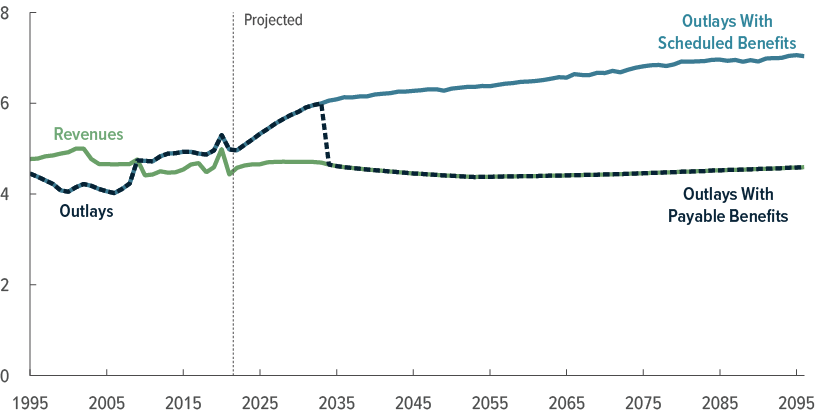
The ups and downs of the trust fund just reflect a change in how we finance spending. While payroll taxes > social security spending, which was the case until 2007, then payroll taxes are financing other spending. When payroll taxes < social security spending, then income taxes or increases in debt are financing social security spending, which (graph below) was the case after 2008.* The trust fund just adds up this change over time. But exhausting the trust fund is, in this view, really irrelevant. 

source: CBO

That doesn't mean we can all go to sleep, for two reasons. First, when payroll taxes < Social Security outlays, and the trust fund is winding down, then income taxes or additional public debt must finance the shortfall. The government has to spend less on other things, raise income tax receipts, or borrow which means raising future taxes. And, per the graph, the numbers are not small. 1% of GDP is $230 billion. The extra strain on income taxes, other spending, or debt, happens right now, when the trust fund is positive but decreasing. 

Zero matters only because by law,  when the trust fund goes to zero, Social Security payments must be automatically cut to match Social Security taxes. That's the sudden drop in the graph. The program was set up as if  the trust fund were buying stocks and bonds, real assets, and would not lay claim on income tax revenues. But it was not; social security taxes were used to cover other spending, and now income taxes must start to pay social security benefits. 

What happens when the trust fund runs out, then?  Congress has a choice: automatically cut benefits, as shown, or change the law so that the government can pay Social Security benefits from income taxes, or, more realistically, by issuing ever more debt, until the bond vigilantes come. (Or raise payroll taxes, or reform the whole mess.) I bet on change the law. 

So what's the right measure of debt? It's conventional to look only at debt in public hands. But there is a case to look at the total debt, i.e. including the trust funds. Those are the total claims against the income  tax. Looking at it this way, however, one could also go on and count unfunded future social security benefits as a debt -- the present value of the difference between the two lines above, which leads to immense numbers, per Larry Kotlikoff. 

I have usually not considered the present value of unfunded promises as "debt," because Congress can change the payments at any time. Changing debt repayment to the public is a default, with financial and legal consequences; changing social security benefits is legislation. You can't sell your future social security benefits as you can sell your treasury debt. The trust fund is half way on this scale. What would be the consequence of a haircut or rescheduling of trust fund debt? Would that trigger something like cross-default clauses in corporate debt? I don't know. The event is unlikely anyway. The left pocket defaulting on the right pocket doesn't help pay the bills. The trust fund is certainly unlikely to run, and its debt is not used as collateral in financial transactions. As a somewhat meaningless accounting identity, it's a lot less "debt" than the debt in public hands. 

I think this all goes to remind us that paying off the existing debt is not the US central fiscal problem. The central problem is vast unfunded future promises. Defaulting or inflating away current debt does nothing to fund those promises. 

I look forward to comments on this one, especialy if there are standard views on these apparently simple questions that I'm not aware of. 

*In the end,  

payroll taxes + income & other taxes + increase in public debt = Social Security spending + other spending. 

The trust fund nets out. 


Sunday, February 12, 2023

Fair/consumption tax adjustment

The main (vocal) comment on my consumption/fair tax post and oped  has been to complain about retirees who have earned income, paid taxes, saved, and now must pay consumption taxes on what they buy with the proceeds. 

When writing an oped, one tries to anticipate a few objections, but not to overdo it. I left this one out because it surely seemed an easy exercise for the reader. This is a problem easily solved with money. If the consumption tax is 30%, then the government can top up retirement savings by 30%. Done. 

It obviously need not be that generous. First, old savers will benefit by not having to pay capital gains tax and estate tax on their savings. That almost adds up to the consumption tax right there! So at best they need a subsidy only equal to the difference between the new consumption taxes and what they will save from the absence of all other taxes. Second, the market is likely to boom. So, subsidy only to the value of investments on the day before the tax is announced. Third, this only applies to old savers. Fans of wealth taxation should be lining up for the consumption tax as it hits high wealth accumulators most! (There is an interesting question whether the CPI will include the consumption tax or not. If so, social security is immediately indexed and rises to pay the tax, thereby greatly benefiting seniors who no longer pay income taxes on social security.) 

But more importantly, in the big government intergenerational transfer scheme, current old people who have saved money came out pretty well. They get a lot more out of social security and medicare than they put in, and a lot more than young people will ever see. Whatever the benefits of 100% debt to GDP are, they got them and their grandchildren will pay them. If one is arguing on distributive justice, leaving the poker game just after you scored a big hand, and then crying about taxes is a bit unseemly.

And I'm sure that's only the beginning. Every reform has winners and losers. Tax lawyers and accountants are going to do terribly!  I assume some muddy mess will emerge to compensate old savers and other politically organized losers.  Government and politics are about transfers. Economics is about incentives. If every change must be completely Pareto optimal, we might as well go back to subsistence farming. 

Friday, February 3, 2023

Fair tax oped

An Oped in the Wall Street Journal on the "fair tax" proposal. As usual, I have to wait 30 days to post the full version 

The bill eliminates the personal and corporate income tax, estate and gift tax, payroll (Social Security and Medicare) tax and the Internal Revenue Service. It replaces them with a single national sales tax. Business investment is exempt, so it is effectively a consumption tax.

I've been writing about consumption taxes for a while. Some previous posts on these points,  VAT (WSJ)A progressive VATConsumption taxTax reformTaxesAlternative Minimum Tax, also  Wealth and Taxes Convexification and complication Tax graph Economists and Taxes Corporate tax burden Tax Reform Tax reform again (WSJ) Corporate tax reading list Corporate tax (zero) Trump taxes 2 Those address a lot of the what ifs and whatabouts. 

But it's not progressive! (Meaning, better off people pay the same rate, not the same amount, not "politically progressive"). 

Already the "fair tax" proposal adds 

Each household would get a check each month, so that purchases up to the poverty line are effectively not taxed.

Yes, effectively universal basic income from Republicans! One could do more. And as in the above forest of links there are plenty of ways to make a consumption tax as progressive as you'd like. 

But the most important point, with added emphasis: 

the progressivity of a whole tax and transfer system matters, not of a particular tax in isolation. If a flat consumption tax finances greater benefits to people of lesser means, the overall system could be more progressive than what we have now. A consumption tax would still finance food stamps, housing, Medicaid, and so forth. And it would be particularly efficient at raising revenue, meaning there would potentially be more to distribute—a point that has led some conservatives to object to a consumption tax.

Even the supposedly far right radical Republican plan bends here to political expediency in my view. Why should this particular tax add progressively, rather than just finance transfers? 

Won't the rate be too high? If the government spends 40% of GDP, and consumption is 85% of GDP, then the consumption tax rate has to be 47%. Wow! 

But taxes overall must finance what the government spends. Collecting it in one tax rather than lots of smaller taxes doesn’t change the overall rate. It’s better for voters to see how much the government takes. 

(Currently taxes don't cover spending because we borrow a lot, but that can't last forever). 

What about "starve the beast." Consumption taxes or a VAT are so efficient, government will grow. Keep an inefficient system so that government is forced to cut spending. While great economists advocated that view, it does not seem to be working! 

BTW, I don't have a big view on consumption tax, sales tax, VAT. From where we are now, all three are about the same. There are differences, that will matter in the end. The fair tax bill actually has a lot of the thought out detail one expects. 

The main point: Get out of the day by day politics. It's great news that a clean good fundamental reform idea is making it to actual legislation. 

This is a big moment. For a long time, consumption taxes have been debated in academic articles, books, think-tank reports, administration white papers and so forth. When the U.S. eventually decides to reform the tax code, consumption taxes will be the obvious answer. It is great news that real elected politicians like Rep. Carter get it, and are willing to stick their necks out to try to get it passed.

No, it’s not likely to pass this year, or next. All great reforms take time. The 8-hour workday and Social Security started as wild-eyed dreams of the socialist party. Civil rights took bill after bill being voted down. The income tax took a long time. But if we never talk about the promised land and only squabble over the next fork in the road, surely we will never get there.

Wednesday, February 1, 2023

RIP Indexed Bonds in Canada

(An oped at Globe and Mail with Jon Hartley) 

Finance Minister Chrystia Freeland recently announced that the government of Canada  will no longer issue inflation-protected “real return” bonds. A kerfuffle erupted.

The government may wish to avoid inflation-protected bonds, because it thinks inflation will get a lot worse than markets do. But betting in markets is not a responsible strategy.

If the government won’t do it, corporations, banks and financial institutions should issue these bonds themselves rather than just complain. Not every asset must be provided by the government.

Real return bonds adjust both principal and interest for inflation. If inflation goes up, you get more money back. Nice. But when everyone expects inflation, you pay a commensurately higher price ahead of time.

With 5-per-cent inflation, say, a real return bond might pay 1 per cent, so you get 6 per cent after inflation adjustment; but a regular bond will pay something like 6 per cent already. Like everything in finance, it’s really about risk: Real return bonds protect against the risk that inflation will turn out worse than bond markets expect. Regular bonds have lost 11 per cent of their real value since January, 2021, because of inflation that markets did not expect. Those who bought real return bonds were protected from this risk.

For this reason, long-term real return bonds are very useful, and ought to be more popular than they are. They can provide a steady stream of real payments immune from inflation or interest rate risk. As such, they can make an ideal component of any long-term portfolio, such as a retirement portfolio or an endowment. So, complain the members of the Canadian Fixed-Income Forum and other Canadian pension managers, it is a huge mistake for the government to stop providing this useful asset. Good point.

The government answers that the bonds are not “liquid,” meaning you can’t always sell them quickly at a good price. But why does the government care about liquidity? The point of bonds to the government is to raise revenue at a good rate, and the point of long-term real return bonds to the investor is precisely to live off the coupons and not to trade them actively. Moreover, if liquidity is an issue, the government can easily improve it by issuing perpetuals and simplifying the bonds’ tax treatment.

So why stop issuing real return bonds? The government may suspect that inflation will go up a lot more, and it will then have to pay more to bondholders. Non-indexed debt can be inflated away if the fiscal situation worsens. The cumulative 11-per-cent inflation since January, 2021, has inflated away 11 per cent of the debt already. Argentines have seen a lot more.

But issuing indexed debt makes sense if the government plans to be responsible. Tax payments and budget costs rise with inflation, and fall with disinflation, so the budget is stabilized if inflation-indexed bond payments do the same. And issuing indexed debt that can’t be inflated away is a good incentive not to turn around and inflate debt away.

Indexed debt is also a very useful signal, as it gives a market-based measure of inflation expectations.

If the government won’t do it, however, there is no reason that the government’s critics can’t issue them. Companies can issue real return bonds, as they already issue U.S. dollar bonds. Banks can offer real return accounts and certificates of deposit.

If the government steps out of the market, there’s all the more demand for private issuers to step in. Pension funds desperate to replace vanishing inflation-indexed government bonds are natural clients. Company profits rise and fall with inflation, so they have a natural incentive to issue bonds whose payments rise and fall with inflation. Even mortgage rates could rise and fall with an index of wages.

Why not? Broadly, this reluctance seems one more symptom of an overleveraged, overregulated, government-dependent and not very competitive or innovative banking and financial system. Banks and other financial institutions only want to issue or expand a new product if they can quickly lay off the risk onto the government, and earn steady fees. The model of issuing equity to bear risk and then offering a profitable innovative product to consumers is too out of fashion.

Bring on the real return bonds. And if government won’t do it, make your own.