Tuesday, January 31, 2023

The Fed and the Debt Limit

What's the matter with a temporary delay in paying interest and principal on debt, if the debt limit hits? Collateral. Financial institutions can easily borrow using treasury securities as collateral.  If a treasury is in technical default, it suddenly can't be used as collateral, or you can borrow much less money with it. Thus even a technical and temporary default, even if we all know Uncle Sam will eventually repay the debt, is dangerous to the financial system. (Why we have so much short term collateralized borrowing is a topic for another day. We do, and unwinding it suddenly would be bad.) 

Earlier I argued that the Treasury should stand up and say "we will pay interest and principal on Treasury debt before we pay anything else." It's important to say that now to avoid a run. I suspect they will do it in the end, but want to use the threat of a crisis to get Congress to raise the limit promptly. If so, they're playing with fire, as runs start ahead of time. 

Today, however, I've been thinking about what the Fed can do. First, the Fed can say right now, in the event of a debt ceiling technical default, we will suspend all our rules and allow financial institutions to lend against treasury collateral with customary (tiny) haircuts, ignoring the technical default. Second, the Fed can say it will lend freely against treasury collateral to banks, or via reverse repos to financial institutions, with no haircut, even if the securities are in default. Third, the Fed can say it will buy Treasurys. It will fix a low rate of interest and buy all anyone wants to sell at that price. Will private markets make some money off this? Yes. Fine. That's the point. Hang on to your treasurys, you'll make some money is a lot better than starting a crisis. If the Fed overpays, it just remits less to Treasury eventually. 

Say it now, so there is no run as the debt ceiling approaches. 

The one thing Fed and Treasury will clearly not be able to do under a debt limit is to run another big bailout. So make darn sure we don't need one! 

What about the trillion dollar coin? Clever, but as before, issuing interest-only debt is even more clever. The debt limit only counts principal, not market value, so interest only debt doesn't count! But both that and the trillion dollar coin are so obviously against the spirit of the debt limit, that if Treasury is worried about its authority to prioritize treasury debt over (say) electric car subsidies, then either is not worth discussing. 

Updates:

Chris Russo wrote in Barrons Sept 2021 reporting on internal Fed strategizing for this event. 

The Fed will treat defaulted Treasury obligations the same as non defaulted obligations. Their regulatory treatment will remain the same including capital requirements and risk weights. Moreover these securities "will not be adversely classified or criticized by examiners." 

Policy makers would "presumably want to avoid the impression that the Federal Reserve was effectively financing government spending." 

The Fed will 

transact with defaulted securities at market prices

Eventually 

The Fed could move the defaulted securities on to its balance sheet [English translation: buy] ...this set of options is the most contentious. Powell described them as "loathsome"... the institutional risk would be huge. The economics of it are right but you'd be stepping in to his difficult political world and looking like you are making the problem go away. Lacker called it "beyond the pale." John Williams... supported keeping those options on the table. ...no Fed governor categorically rejected the third option. 

As I read it, this is considerably less than what I described. The Fed worries here about not inadvertently forcing individual banks to treat treasury assets as defaulted securities, which is good. But the main issue is whether financial markets, many not banks, will accept treasury collateral for lending, or whether we have as in 2008 a grand unwinding of the chain of short-term financing due to lack of collateral. Only the "loathsome" option addresses that issue as far as I can see. And if you want to stem a collateral run, it's best to clarify ahead of time. 

Casey Mulligan inquired

I am confused about your proposal.  Fed is part of the government. With currency in circulation not (?) counting against the debt limit aren't you suggesting the Treasury debt be (contingently) replaced with currency? Or would the Fed be defaulting on whatever asset it lends out?

Boy, if I didn't explain it well enough for Casey, I must really need a remedial writing course. Answer/clarification: 

Sorry if not clear. Fed can buy / lend against existing treasury debt, in default, and offer cash/reserves in exchange. This solves the financial crisis issue. It does not allow the treasury to borrow more, or the Fed to finance deficits. 


Saturday, January 21, 2023

A fiscal theory fest at AEI, launch podcast, and official release.


Mark your calendars! February 28th 3:00 PM eastern the AEI's Michael Strain will host a zoom event on Fiscal Theory of the Price Level. Info and registration here. 

This event will be particularly good because Michael convinced Robert Barro, Tom Sargent, and Eric Leeper to come and discuss. These are the giants on whose shoulders I meekly stand. 

Robert Barro did the modern version of "Ricardian Equivalence." If people look at government debt and understand that there will be taxes to pay it off, they save and the deficit (with lump sum taxes) has no effect. He also did the modern version of tax smoothing. It is good government policy to borrow in bad times, and repay in good times, with steady low taxes, rather than raise distorting tax rates a lot in bad times. Both underlie fiscal theory,  

Tom Sargent, with Neil Wallace wrote “Unpleasant Monetarist Arithmetic,” the cornerstone of the modern fiscal theory. They pointed out that if fiscal policy is stuck in deficits, monetary policy can only choose to inflate now or inflate later. Tom went on to write many fantastic papers on the theory of fiscal-monetary interactions, and on their place in economic history. His "ends of four big inflations" showed that the great post WWI hyperinflations ended when the fiscal problem was solved, involving no monetary stringency. A good lesson, now mostly forgotten in the widespread view that ending inflation must come with misery. His Nobel speech “United States Then, Europe Now” is a great example of historical work. In my view, the Nobel Committee should have given him a prize for monetary-fiscal interactions, which is even better than the econometric work they cited. Maybe he'll be the first economist to get two.    

Eric Leeper is the original innovator of the modern fiscal theory in his paper "Equilibria under ‘active’ and ‘passive’ monetary and fiscal policies. " Eric put fiscal theory in the context of interest rate targets, r rather than money supply, which is how all our central bankers operate, and includes nominal rather than real debt. Thus, he integrates fiscal theory with how our monetary policy actually works, creates the essential model of inflation under interest rate targets, and integrates fiscal theory with modern new-Keynesian or general equilibrium models that are 99% of all applied work. 

I'm going to try to be as brief as possible so we can hear from these amazing economists, plus Michael, no slouch himself. This much talent can't possibly sit still and not say things that are a bit critical, and thought provoking. 

****


Vince Ginn of the "Let People Prosper" Podcast did a very nice interview on FTPL.  Like many economists, Vince has a good monetarist heart, and explaining the difference between FTPL and monetarism was useful for me. 

****

As of January 17, The Fiscal Theory of the Price Level is formally released! Along with this good news, I have some bad news -- I have to take down the free version on my website. However, keep that in mind for the (sadly) evolving typo list, sample chapters, online appendix, follow on essays, and revisions as they come. I already have a revised Chapter 5 posted, which does a better job of introducing fiscal theory in standard new-Keynesian models. 


Wednesday, January 18, 2023

Two points on the debt limit, 1 serious 1 fun

Everyone keeps repeating that hitting the debt limit would necessitate a default on principal and interest. The Treasury itself says 

Failing to increase the debt limit would have catastrophic economic consequences. It would cause the government to default on its legal obligations – an unprecedented event in American history. That would precipitate another financial crisis and threaten the jobs and savings of everyday Americans – putting the United States right back in a deep economic hole, just as the country is recovering from the recent recession.   

The first statement is correct. The second is not. The government is still hauling in tax revenues. The Treasury could easily say "given the catastrophe that a default would produce, we will always pay interest and principal on treasury debt before any other payment." Congress could pass a law stating that fact. There is no economic reason  that a debt limit should force a default. 

There is a legal argument, and a claim that the Treasury cannot prioritize debt payments over other legally mandated payments. In the research I've been able to do however, this is a very uncertain claim. And it makes no sense. The Treasury is legally obligated to make debt payments, as it is obligated to pay Social Security checks, and also legally obligated not to borrow. Law prescribes the impossible. It has to prioritize. Indeed, unpaid bills are a form of debt, so if you want  to be a stickler, the government will violate the debt limit no matter what it does. 

The second statement is false. The US has defaulted on  gold clauses in the 1930s. It has defaulted on other "legal obligations."

The third is correct, and appropriate. If we are to tussle over paying Wall Street fat cats vs. grandma's social security, keep in mind just what a catastrophe default would be. Grandma will be way worse off if that happens. Treasury debt is now the golden collateral, supporting most of the financial system. (We should have a financial system much less dependent on short term collateralized borrowing, but that's another story.) If in default it would not be. Worse, and most important here, if financial markets suspect a default will really happen, they will start refusing to accept treasury collateral in the first place. This is basically what happened in 2008 with mortgage backed securities. They didn't fall to pieces,  they just weren't acceptable as collateral any more. 

A flight from treasury collateral under a debt limit would be far worse. And the government's magic tonic, borrow a ton and bail everyone out, would be unavailable. 

Perhaps Treasury thinks that by threatening default, they can get Congress to wake up and raise the debt limit promptly. But this risks Wall Street also believing the threat and causing the panic you're trying to prevent. 

Treasury secretary Janet Yellen should say out loud, right now "we pay principal and interest on treasury debt first, before anything else." President Biden should back her up. Drastic delays in social security, medicine, government shutdown and more are plenty enough threat to get Congress to move, without risking a run. 

States with balanced budget rules are interesting legal precedent. The State of Illinois, while I was watching, simply delayed payments, often by years. It paid its bonds on time. That isn't a good outcome of course, but it represents the State's choice of how to handle the legal requirement to pay vendors and to pay interest and principal on bonds. Other states have defaulted as have cities and counties. And countries. 

*****

Now for fun. Just print money, some say. Fortunately, our legal system is full of mechanisms to prevent the government from printing money instead of borrowing it. The treasury has to issue debt; the Fed has to buy it,  and thereby give the Treasury new money to spend.  That violates the debt limit. But Treasury can create coins. So, last time, the fun suggestion of $1 trillion dollar coins came up. 

Here is a novel proposal in the same sprit. The debt limit is calculated based on face value, not market value of debt. A bond promising $100 in 10 years and $3 coupons from now to then counts as $100 of debt. So issue perpetuities. Or, more realistically, issue coupon only debt.  The government could issue a bond that pays a $3 coupon for 30 years and no principal payment. As things are now calculated, that bond adds zero to the debt! 

Like the trillion dollar coin, this proposal so clearly violates the spirit of the debt limit that I doubt serious people would do it. It does point to a serious shortcoming in how the Treasury calculates debt however. Most of the time Treasury issues debt at par, borrowing $100 and promising to repay $100 in 10 years. Then the distinction does not matter. But the formulas should be fixed. 

Disclaimer: I'm not an expert on the law of the debt limit. If these points are in error, let me know and I'll issue a "never mind." 

****

To clarify, this is just a fun way to get around the debt limit if one wants a fun way to do it. It's not obvious that getting around the debt limit is a good idea. What is the justification for running primary deficits right now? No, I'm not a balanced budget nut. In times of crisis, war, pandemic, and recession, the government should borrow, for standard tax-smoothing reasons. But then the government should repay the debt. When the economy is humming and there is no crisis on, we should be running small steady primary surpluses. That is now. One has to argue that yes, we should get there, and stop borrowing in good times,  but it's too hard to do all of a sudden. But just what are those adjustment costs? A crisis is a terrible thing to waste. Today is as good a day as any to clean up the US long term fiscal mess. It's not clear to me that Washington does anything better if it takes a long time to do it. 


Saturday, January 14, 2023

Waning inflation, supply and demand.


Source here

Inflation seems to be waning. The conventional change from a year ago: 


The month to month changes now suddenly more popular on the way down than it was on the way up: 


I generally don't make predictions -- unconditional forecasting is a fraught game in economics. But I have been as far out on a limb this year as I ever have in thinking this is possible and even likely. 

The standard fiscal theory 101 says that a $5 trillion fiscal blowout will lead to an increase in the price level, to inflate away outstanding debt. But that inflation eventually goes away, even if the Fed does nothing. It goes away a little faster if the Fed raises rates. The central graph: here's what happens in response to a big fiscal shock, if the Fed does nothing. Inflation rises but fades away as the new debt is inflated away. (π is inflation, x is output gap (output-steady state or potential), p is price level, i is interest rate. This is an impulse response function, how the variables change in response to the shock, hence based at zero.)

So, while inflation was still increasing, starting here, last March,  here at length for the Hoover monetary policy conference published as "inflation past present and future," more distilled here with the first draft of "fiscal histories," here with the clarity of continuous time models, here in the WSJ and  here with pictures,  here in the first draft of "expectations and the neutrality of interest rates," I did go out on a limb with the view that inflation would abate, even without the Fed dramatically raising interest rates. Then, updated here as inflation did after all start to ease. (Hmm, I seem to be making the same point a few too many times!) 

I call this the "second great experiment," as conventional theory says the Fed needs to dramatically raise interest rates above current inflation to bring inflation down. 

Now, to Luther's point. Is this not a victory lap for "team transitory," the view that inflation is just "supply shocks" that go away on their own? 

No. A "supply shock" would raise prices temporarily, and then prices would fall back down to normal once the supply shock is over. A supply shock all on its own cannot permanently raise the price level. How is the price level doing? 


The cumulative inflation has shifted up the price level by something like 10-20%, depending what you think about the earlier trend. The pure "supply shock" view says that we should now experience a symmetric period of deflation to bring the price level back to where it was, or at least to that plus a 2% trend.  The fiscal theory or "demand" view says that this price level shock is permanent, or at least until something else comes along; a fiscal retrenchment would be necessary to lower the price level back to where it was. 

Well, it hasn't happened yet. The current end of inflation does not prove the "supply shock" view right. Perhaps it will. If we get a period of 10% deflation, just as unrelated to Fed action as the inflation was, then the supply shock view can take a turn of "we told you so." Though, of course, nothing in economics is ever so simple. 

What happens next? In the simple fiscal theory model, the Fed can lower inflation today, but only by making future inflation a bit worse. That is desirable too. For the recent Hoover economic policy roundtable, I made the following graph: 

The beginning is the same as the last graph -- the response to a 1% fiscal shock when the Fed does nothing. Now I ask, what if the Fed waits a year and then starts raising rates. You see in the short run the Fed does bring down inflation faster than it would otherwise go down. However, we have to inflate away debt at some point unless fiscal policy wakes up and decides to pay it back more aggressively. So we get more inflation in the long run. I call that "unpleasant interest rate arithmetic." 

This leads me to worry about a 1975ish future: 


Inflation goes down without dramatic Fed intervention, we all cheer, but then it gets stuck maybe around 4%. And we wait for the next shock, amid eerily 1970s arguments that we should get used to inflation, raise the inflation target, it's too costly to bring it down, or that it's really all about worker-manager conflicts of price gouging anyway. 

I'm more leery of this one however. The graph of the effects of monetary policy has more unsettled ingredients in it. Still, you have to go with the model you have, not the model you wish you had. 

On a note of optimism, the long-run expected inflation and price level remain in the Fed's control, even in my fiscal theory model. After the fiscal blowout has been inflated away, the Fed can gently normalize. The stair step is not realistic of course, but designed to show the mechanism. 


But some new fiscal or monetary shock will surely intervene before we see this. That's one of the main dangers of economic forecasting, what I called "unconditional" above. All we can hope to do is to say what is expected to happen, what will happen on average over many situations like our own. But what actually will happen depends primarily on whatever shocks hit us next. So as rhetorically attractive as it is to point fingers at the right field bleachers and announce where the home run will go, that's not how it works. Even if a prediction is the best it can be, right on average, it will be wrong about half the time. So beware evaluating any economic model, including mine, on single data points, and the rhetorical magic of ex ante predictions. On the other hand they do add up weight of evidence. 


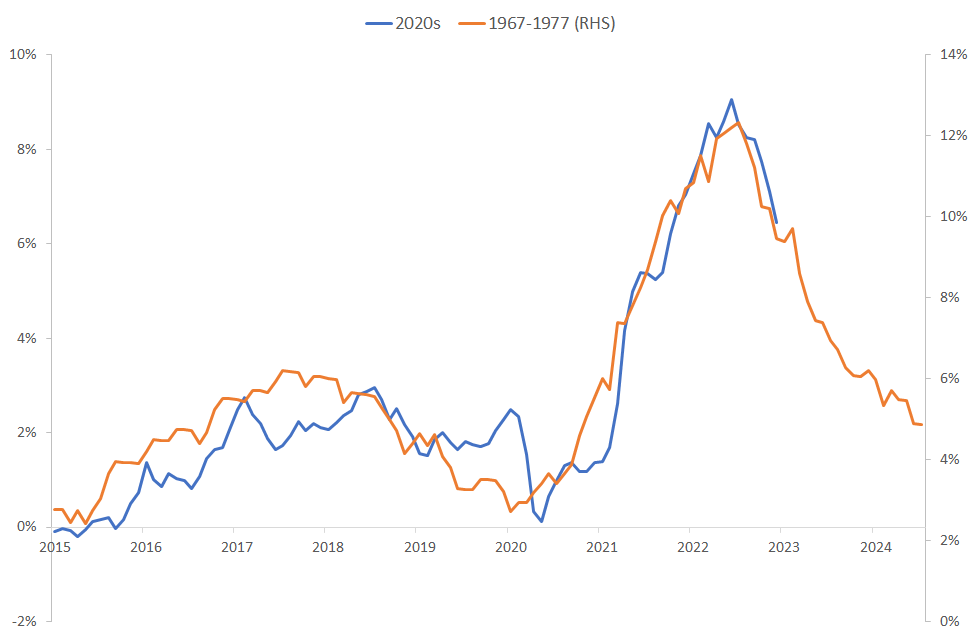
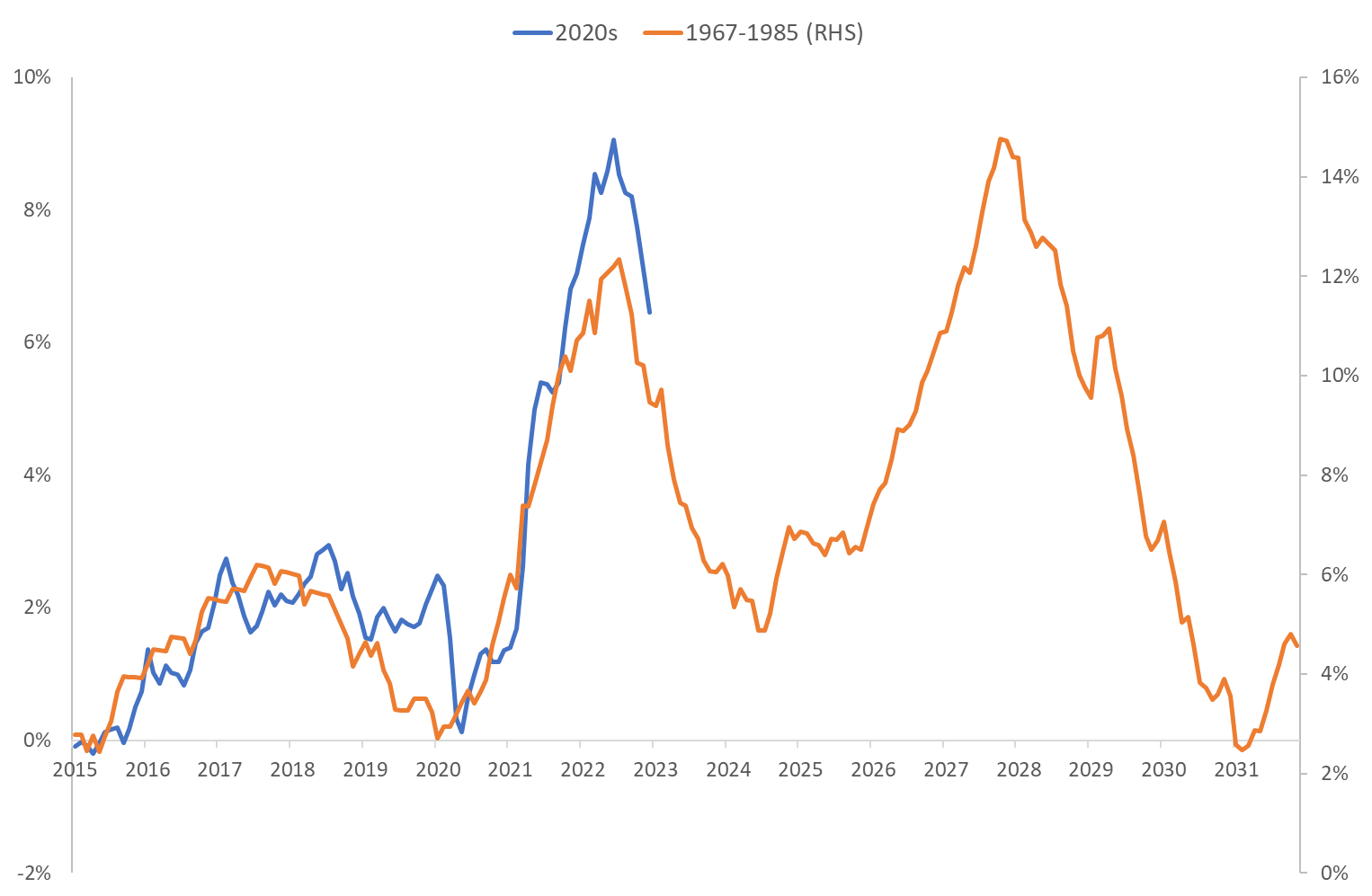
Update: Jesper Rangvid overlays inflation in the late 1960s through 1975 to inflation today, 


If this makes you feel better, he then plots inflation through the early 1980s, 

Now you see more accurately my worry about our own future. Easing inflation, a recession, a fiscal blowout (1975 was the largest primary deficit since WWII), an oil shock, and here we go again. 

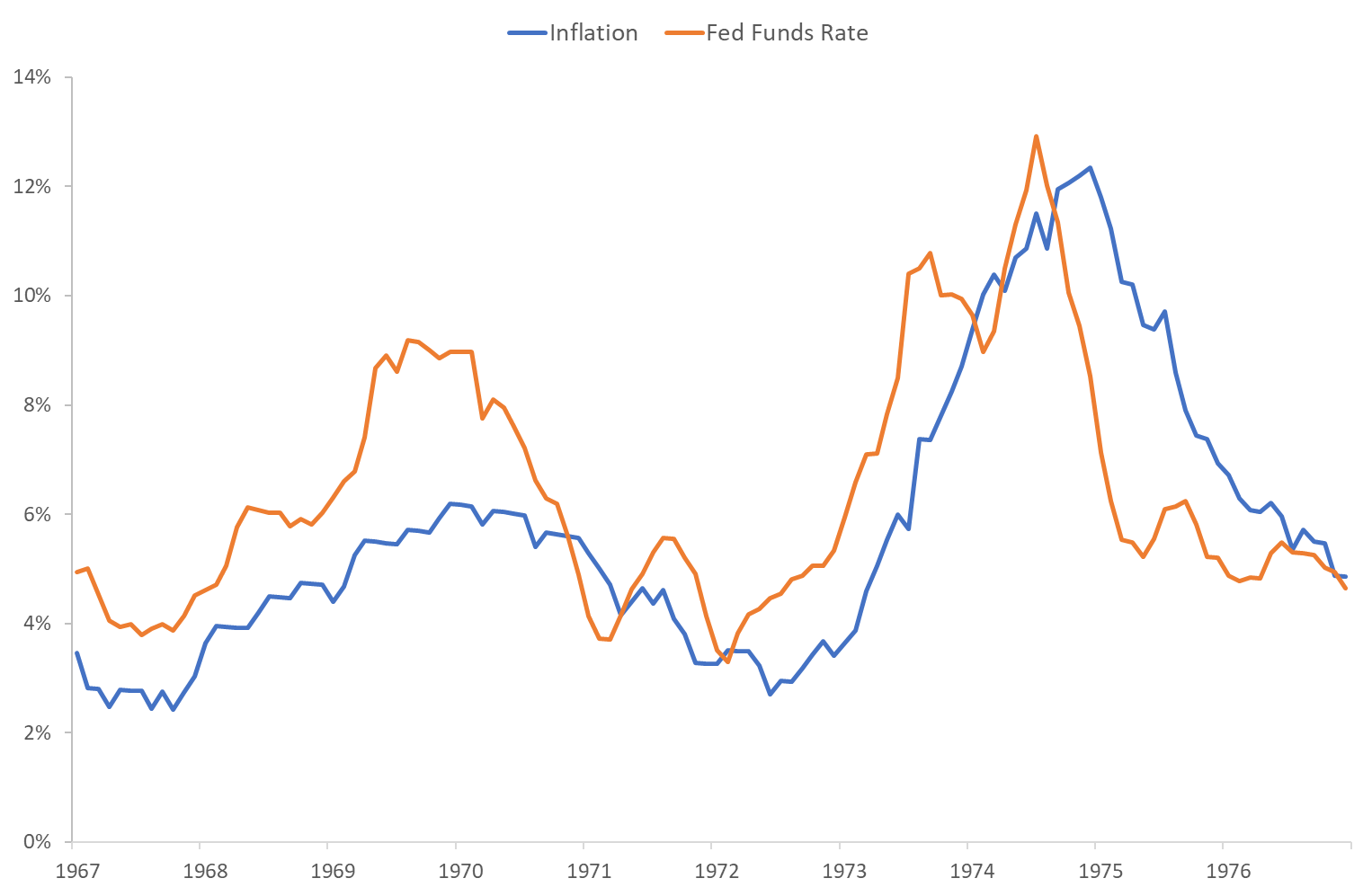
Jesper points out however the vastly different Fed response to inflation now vs. 1975. Then: 


Now: 


This comparison suggests one of two possibilities. 1) This time will be different. 2) The Fed is a lot less powerful for good or bad than you think. 

See Jesper's blog for much more thoughtful commentary. 


Tuesday, January 10, 2023

Cheers for Powell

 Jay Powell's Stockholm speech lays it out with Gettysburg address clarity and brevity. Relative to usual central-bankerese it's soaring rhetoric too. 

...Decisions about policies to directly address climate change should be made by the elected branches of government and thus reflect the public's will as expressed through elections.

... without explicit congressional legislation, it would be inappropriate for us to use our monetary policy or supervisory tools to promote a greener economy or to achieve other climate-based goals. We are not, and will not be, a "climate policymaker."

So much for "all of government" approach announced by the administration. Would that the SEC and other regulators would listen.  

Powell carefully and correctly links this path to the US institutional structure. The Fed has independence, in return for sticking to its mandate. 

In a well-functioning democracy, important public policy decisions should be made, in almost all cases, by the elected branches of government. Grants of independence to agencies should be exceedingly rare, explicit, tightly circumscribed, and limited to those issues that clearly warrant protection from short-term political considerations.

Footnote 7 is important. 

While U.S. monetary policy has the dual mandate of maximum employment and price stability, some other central banks have somewhat more expansive mandates. The Bank of England and the European Central Bank both have a primary mandate to maintain price stability but a secondary mandate to support the economic policies of the U.K. government and the European Union, respectively..

My emphasis. Now, not even in the EU and UK do central banks have the freedom to create their own climate policies in advance of governments. And governments come and go and change their minds. Now that Europe is full-bore trying to invest in natural gas as fast as possible, and even bringing back coal, it will be interesting to see if ECB and BoE regard their roles as supporting the new economic policies of their governments, or whether they will decide to act independently to pursue an anti-carbon policy different from those of their governments. 

OK, he waffles a bit: 

Today, some analysts ask whether incorporating into bank supervision the perceived risks associated with climate change is appropriate, wise, and consistent with our existing mandates.... 

These responsibilities are tightly linked to our responsibilities for bank supervision..

..  The public reasonably expects supervisors to require that banks understand, and appropriately manage, their material risks, including the financial risks of climate change.

But read closely. "perceived." "material." I would have said "it's perfectly obvious that 'climate financial risk' is BS." But I'm not Fed chair. "Perceived" is darn close! And advocates will have to show that climate is "material" to banks, not just how important climate policy is, and how the Fed must act because legislature does not. 

As Lincoln cast the civil war in the context of the Declaration of Independence, so Powell  casts the climate policy in the context of Fed independence. Only by hewing tightly to the mandate can the Fed preserve the independence it will soon need: 

The case for monetary policy independence lies in the benefits of insulating monetary policy decisions from short-term political considerations. Price stability is the bedrock of a healthy economy and provides the public with immeasurable benefits over time. But restoring price stability when inflation is high can require measures that are not popular in the short term as we raise interest rates to slow the economy.

The Fed's anti inflationary tool is precisely to cool the economy. Great political displeasure is heading the Fed's way, and only by eschewing the temptation to be the great "policy-maker" that solves all problems can the Fed do its  central job. 

It is essential that we stick to our statutory goals and authorities, and that we resist the temptation to broaden our scope to address other important social issues of the day. Taking on new goals, however worthy, without a clear statutory mandate would undermine the case for our independence.

 I wish I could ever write something with such clarity and brevity. 

Friday, January 6, 2023

Strassel insight, and cheers for a long speaker tussle

I'm a policy wonk, but I care very little about politics, who is up and who is down. The house speaker voting coverage has been largely the latter, with no more than the usual tropes about "normal Republicans" vs. "Radicals" suffused with Trump-loving election-denying fervor.  

The WSJ's Kim Strassel, whose fact-filled columns are always a delight, explains that there actually are important issues at stake here: 

Committees barely function. Members have no ability to debate or amend. Leaders disappear into back rooms to cook up mammoth bills that are dropped on the floor for last-minute take-it-or-leave it votes. Add Mrs. Pelosi’s Covid “proxy” voting rules, and most of the House didn’t even bother to clock in.

Under the proposed new rules package, committees are back in charge of legislation, with rules designed to ensure that bills address single subjects—rather than catch-all legislation. It similarly gives members new power to challenge amendments that aren’t related to the topic at hand. And it revives “Calendar Wednesday,” whereby any committee chairman can bring a bill straight to the floor.

It includes new provisions for accountability and transparency. Proxy voting is history, as are virtual committee meetings. It requires a 72-hour rule to give members time to read legislation. It ends Democrats’ wild experiment with staffer unionization, which threatened to tie the chamber up with crazy demands. 

And it makes it much harder for the House to tax and spend. It imposes a “cut go” rule—requiring any mandatory spending increases be offset with equal or greater mandatory spending cuts. A three-fifths supermajority vote will be required for tax increases. It revives what’s known as the “Holman rule,” allowing appropriations bills effectively to defund the salaries of specific executive-branch officials or specific programs. It also requires each committee to submit an oversight plan that lays out what action it intends to take on unauthorized or duplicative programs.

These changes will produce the first functioning House in years, even as they tie the hands of spenders.

This all sounds pretty good to me. Strassel goes on 

Take the win! Instead, the rebels continue to hold out for provisions that have the potential to negate this victory by plunging the House back into chaos. At the top of the list is the continued demand to allow any Republican member to call for a motion to “vacate the chair”—essentially a snap vote to oust the speaker.

 Eliza Collins also reports intriguingly:

The night before the first speaker vote, Reps. Lauren Boebert of Colorado, Scott Perry of Pennsylvania and Matt Gaetz of Florida went to Mr. McCarthy with a list of requests, which they said could get him to 218 votes if he committed to all.

That package included demands that Mr. McCarthy promise to hold a vote on a proposal to secure the border put forward by Texas Republicans, a vote to place congressional term limits, and a tax bill that would replace income, payroll and other taxes with a consumption tax. The group also asked for any "earmark," or funding projects specific to a members' district that get tacked onto legislation, to be approved with a two-thirds vote and that anytime an amendment to cut spending is proposed it be brought to the floor.

 "a tax bill that would replace income, payroll and other taxes with a consumption tax" is just the sort of thing that MSM portray as lunatic radical rightwingism. And is music to my ears. Real legislators in real Washington DC are really thinking about trashing our insane income tax and replacing it with something simple and much less distortionary.  Just a whiff of Trump's tax returns ought to convince you just how rotten our system is. 

(I've written about this many times before. Before you go nuts about inequality, a consumption tax can be as progressive as you like, and can fund all the transfers you like. We should split the tax code into a revenue raising code based on a consumption tax, a subsidy code with on-budget expenditures in place of hidden tax deductions, and a transfer code with on-budget checks written to whomever our democracy deems worthy.) 

I'm not in favor of term limits and probably not a fan of the Texas Republican's approach to immigration. But 9/10 is pretty good. And the point, serious political reform and policy discussion is going on here. 

There is a lot of handwringing about "dysfunction" but I'm not so sure. Parliamentary democracies -- Israel, most recently! -- go through long periods of negotiating to form a government. That's what's going on here. This is a moment where serious big changes are being discussed. Congress is dysfunctional. Going back to something like regular order, and contemplating the big policy changes that have been stymied for decades is important.  Once a speaker is in, we're likely on autopilot for two years as far as these big questions are concerned. Let the wrangling go on! 

And kudos to these two for actually listening and reporting on what is going on, rather than passing on the usual tropes. 

****

Update: The comments have gone off on a tangent involving consumption taxes. See here for how to structure a progressive VAT. Applying lower tax rates for tacos than for Lamborghinis is a terrible way to make consumption tax more progressive. The proposal shows how to do it with the same tax rate on every good, by exempting the first x thousand of consumption from the tax. 

Better, we can also stop trying to do two things with one tool. Have a flat VAT, and use the money to send checks to whomever you want to send checks too. Each separate instrument need not be progressive, what counts is the progressively of the whole tax and transfer system. 


Wednesday, January 4, 2023

Fun Fisherian Graph


In working on a revision to fiscal theory of the price level chapter 5 on sticky price models, and a revision of "Expectations and the neutrality of interest rates" I came up with this fun impulse-response function. It  has an important lesson about interpreting impulse response functions.


It's a response to the indicated interest rate path, with no change in fiscal policy, in a simple new-Keynesian model with short-term debt. 


Rational expectations new-Keynesian models have the implication that higher interest rates raise inflation in the long run. They also tend to raise inflation in the short run. I've been looking for better mechanisms by which higher interest rates might lower inflation in the short run in these models, without adding a contemporaneous fiscal austerity as standard new-Keynesian models do. Fiscal theory explores a model based on long-term debt that does the trick, but has a lot of shortcomings. So I'm looking for something better. 

This graph has only short term debt. I generate the pretty interest rate response by hand. It follows \(i_t=30e^{-1.2t}-29.5e^{-1.3t}-0.05.\) Then I compute inflation and output in response to that interest rate path. 

Wow! Higher interest rates lead to high real interest rates,  send inflation down, and create a little recession. Once inflation is really lowered, the central bank can lower interest rates. The price level (not shown) falls nearly linearly, as we often see in VARs.   

Doesn't this look a lot like the standard story for the 1980s? A big dose of high real rates lowers inflation, and then the Fed can follow inflation downward and get back to normal at a lower rate. 

That analysis is totally wrong!  In this model, a higher interest rate always leads to higher inflation in both the short and the long run.  Inflation is a two-sided moving average of interest rates with positive coefficients. Inflation declines here in advance of the protracted interest rate decline starting in year 2. Lower future interest rates drag inflation down, despite, not because of the rise in interest rate from year 0 to year 2, and despite, not because of the high real interest rates of that period. Those high real rates add interest costs on the debt and are an inflationary force here.  If the central bank wants a disinflation in this model, it will achieve that sooner by simply lowering interest rates immediately. The Fisherian effect will kick in faster, and it will not be fighting the fiscal consequences of higher interest costs on the debt. 

Beware facile interpretations of impulse-response functions! It would be easy to read this one as saying high interest rates bring down inflation and cause a recession, and then the central bank can normalize. But that intuition is exactly wrong of the model that produces this graph.  


The model is \[ \begin{align*}
E_t dx_{t} & =\sigma(i_{t}-\pi_{t})dt\\
E_t d\pi_{t} & =\left( \rho\pi_{t}-\kappa x_{t}\right) dt \\
dv_{t} & =( rv_{t}+i_t-\pi_{t}-\tilde{s}_{t}) dt  \end{align*}\] Parameters are \(\kappa = 0.1, \  \sigma = 0.25,\   \rho = 0.1,\ r = 0.01.\) I used a lot of price stickiness and an unrealistically high \(\rho\) to make the graph prettier.  

Update: For Old Eagle Eye. I'm plotting an impulse response function. Variables start at zero, there is one shock, then we solve the deterministic version of the model. The system has two variables with expectations, and two unstable eigenvalues. So we solve forward to determine the initial conditions uniquely. All explained in FTPL, see especially the new Chapter 5 and pointer to the Online Appendix with formulas.